There is something about Hogmanay in Scotland that feels different from New Year celebrations elsewhere. It isn’t only the fireworks or the fizz – though Edinburgh does both spectacularly. It’s the sense of old traditions lingering at the edges of the day, the feeling that the year is turning not just on a calendar but somewhere deeper: in our homes, our hearths, our families.
For all the scale of Edinburgh’s world-famous street party – a dazzling, joyous crush of music and fireworks – Hogmanay has always felt, to me, like a celebration best held in smaller circles. A night for reflection as much as revelry, and a chance to welcome the new year with the people who matter most. While the Scottish capital puts on a show like no other, not everyone is keen on crowds, late nights or cold cobbled streets. If you’re celebrating Hogmanay as a family, there are quieter (and much cosier) ways to bring in the bells while still embracing the traditions that make this night unmistakably Scottish.
The Magic of Old Traditions
Before any fireworks burst over the Castle or “Auld Lang Syne” rings out at midnight, many Scottish families mark Hogmanay daytime with small rituals that symbolise clearing out the old year. It’s a quieter kind of preparation – one that sets the tone long before the bells.
Redding the House (New Year’s Eve Day)
“Redding” simply means cleaning and preparing the home. Traditionally, Scots would spend the daytime on 31 December sweeping the hearth, tidying rooms, and finishing off tasks so that no old year’s mess was carried into the new one.
While very few of us follow this strictly now, there’s something wonderfully grounding about it: wiping down the kitchen, changing the bedding, or preparing breakfast for the next morning. A tidy home to step into on 1 January feels genuinely symbolic – like clearing mental space as well as physical.
First Footing: After the Bells at Midnight
Once midnight comes and the fireworks fade, now is the moment when First Footing begins. The first person to cross your threshold in the new year is believed to bring luck. Traditionally, this “first foot” was a dark-haired man carrying small gifts – coal (warmth), shortbread (food), whisky (good cheer).

Modern families make this tradition their own. Some step outside together just after the bells and return to the house as a symbolic “first foot”. If you have children, this can be one of the most joyful moments of Hogmanay: letting them carry a biscuit or a little battery candle, explaining that they’ve just brought light and luck into the house. Superstitions become stories, and stories soon become traditions of your own.
Why We Sing Auld Lang Syne
Every year we belt out Auld Lang Syne (usually off-key, occasionally with enthusiasm), but how often do we pause to remember why?
Written by Robert Burns in 1788, the song wasn’t originally tied to Hogmanay at all – but its themes of friendship, memory, and holding on to what matters made it the perfect anthem for a night of endings and beginnings. Singing it in a circle, hand-in-hand, is a reminder that the past and present mingle at the year’s turning. For families, it’s a lovely ritual: a gentle tribute to old memories, and a hopeful nod to the ones we’ll create next.
Edinburgh’s Hogmanay: Spectacular, but Not Always Family-Friendly
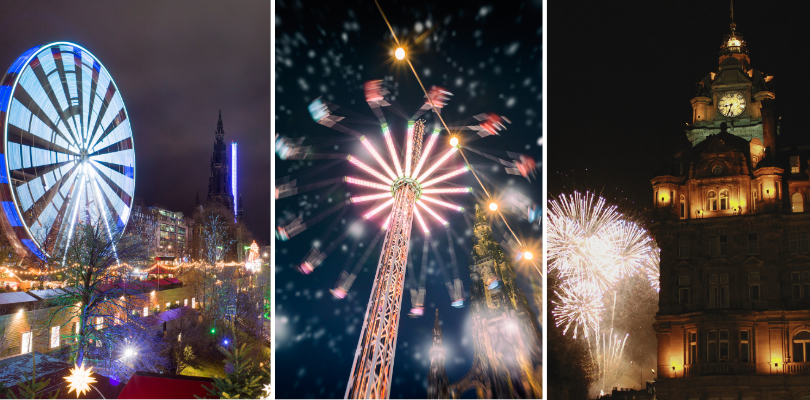
Edinburgh’s Hogmanay celebrations are known the world over. The city lights up with energy, colour and sound – from the Street Party to the towering fireworks over the Castle.
But let’s be honest: as magical as the atmosphere is, the crowds can be overwhelming. It’s a night designed for grown-ups who love live music and shoulder-to-shoulder excitement, not for young children who are asleep by 9pm or anyone who finds crowds stressful.
If you want to capture some of the Hogmanay spirit without squeezing through thousands of revellers on Princes Street, there are brilliant alternatives in the days around New Year:
The Torchlight Procession
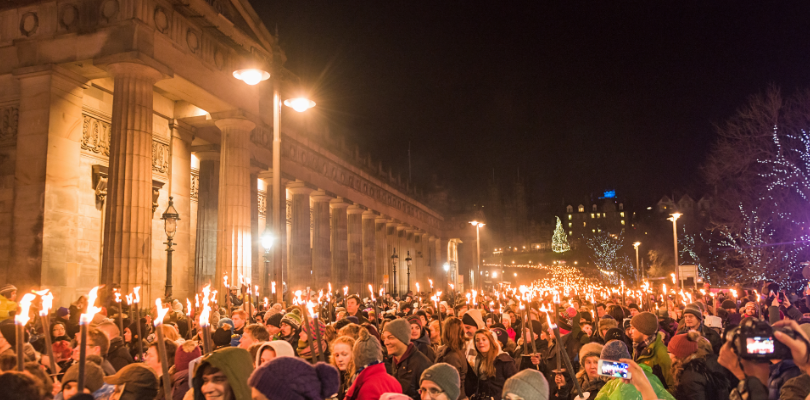
Held on 30 December each year, Edinburgh’s annual Torchlight Procession is one of the most breathtaking sights of the season. A river of flame winds through the Old Town, carried by families, friends, visitors and Vikings (yes, Vikings). It’s loud, busy, and exciting but has a more relaxed, communal atmosphere than the Street Party itself.
Castle of Light
Running through late November to early January, Castle of Light transforms Edinburgh Castle into a storybook of light and colour. Beautiful, atmospheric, and not too late at night, it’s a perfect festive outing for families wanting a little magic without the midnight bells.
Dates:
- 21–22, 28–29 November
- 5–7, 12–14, 19–23, 27–30 December
- 2–4 January
The Loony Dook
If you prefer your New Year’s Day lively, the Loony Dook might become your new favourite tradition. Hundreds plunge into the freezing Forth – some in full fancy dress, some in “I’ll just roll up my trousers” hesitation – raising money for charity. It’s wonderful viewing for children (and excellent encouragement to stay wrapped up warm on the shoreline).
Sprogmanay
If your kids have energy to burn on the 1st of January, Sprogmanay offers crafts, music, play and a family dance – with Unicorn Dance Party – at the National Museum of Scotland. It’s the perfect antidote to late-night festivities and a gentle way to ease into the year. On from 12pm-5pm this event is free!
Edinburgh Zoo’s Lantern Trail
Back for the first time since 2019, this year’s underwater-themed lantern trail is an enchanting (and calming) winter walk at Edinburgh Zoo. With glowing jellyfish and towering illuminated turtles, it’s a perfect early-evening experience for families seeking something special. It’s a pricey one – but a memorable way to mark the New Year,
A Slow, Family Hogmanay at Home
For many of us, though, Hogmanay is best celebrated quietly – with good food, cosy blankets, and children who drift off before midnight while grown-ups stay up and chat softly about the year past and the year ahead.
Create Your Own Rituals
Maybe it’s choosing one special dessert you only make on the 31st. Maybe it’s a family walk at dusk, noticing the lights in neighbours’ windows. Maybe it’s writing down one memory from the year you want to keep. Connection to tradition, to memory, to one another. And perhaps that’s why Scotland celebrates it so wholeheartedly: because when the year turns in the dark of winter, we turn toward what matters – warmth, friendship, and the promise of new beginnings.