Books Set in Edinburgh: A Year in Reading the City
This year, I’m setting out on a literary tour of Edinburgh — twelve months, twelve books, all set in Edinburgh. I’m not being strict about genre or audience: children’s stories, literary fiction, crime, fantasy — anything goes, as long as it’s rooted here. I want to see how writers capture this place, how its streets and skies shape the stories that happen within it. Edinburgh is a city that invites imagination. Every close seems to whisper; every skyline promises another story – and I don’t think I’m really making the most of that.
So I started one that I had read before but it dives deep into the city’s bones: Jenni Fagan’s Luckenbooth. I think it’s a great read for ‘spooky season’ – perhaps not my favourite but it remains on my shelf…
The Story and the Spell
In Luckenbooth, the Devil’s daughter rows to Edinburgh in a coffin. It’s 1910, and she’s come to serve as maid to the Minister of Culture and his wife — a man who hides a double life and a woman who hides heartbreak. But the real reason she’s there is darker still: she’s been sent to bear them a child, since the wife is barren. The act unleashes a curse that clings to the tenement building at No. 10 Luckenbooth Close for the next hundred years.
Each chapter shifts us upward, floor by floor, decade by decade. The stories of the tenants intertwine, echo, and repeat. We meet a civil rights lawyer, a Beat poet, a spy, an artist, a stripper, and even the city’s most infamous Madam. The building becomes a living thing — a keeper of secrets, a stage for sin and survival. Fagan moves from 1910 to the 1990s, and in each era she captures something of Edinburgh’s changing identity: the bohemian underbelly, the literary salons, the working-class resilience, the ghosts of its past.
It’s a challenging book — one that’s not afraid to disorient. The structure is fragmented and sometimes feels dreamlike or surreal. But there’s a strange magic in that disarray. Fagan’s writing is rich and fierce, full of sensory detail and rhythmic language. At times, it feels more like a spell than a novel.
The themes are ambitious: sin and redemption, creation and destruction, the cyclical nature of trauma. There’s also a deep feminist undercurrent, exploring the ways women’s bodies and lives are controlled, commodified, and sometimes reclaimed through defiance. The supernatural elements — ghosts, curses, seances — work as both metaphor and narrative force.
That said, the book doesn’t always hit its mark. The pace falters in places; the shifts between timelines can be jarring, and a few characters are sketched too briefly to fully breathe. But Fagan’s vision is so singular, her world so vividly realised, that even when it confuses, it never bores.
⭐ 3/5 stars — strange, bold, and haunting. It doesn’t always cohere, but when it does, it’s electric. Luckenbooth is less a story you read than one you inhabit — a fever dream of Edinburgh’s darker heart.
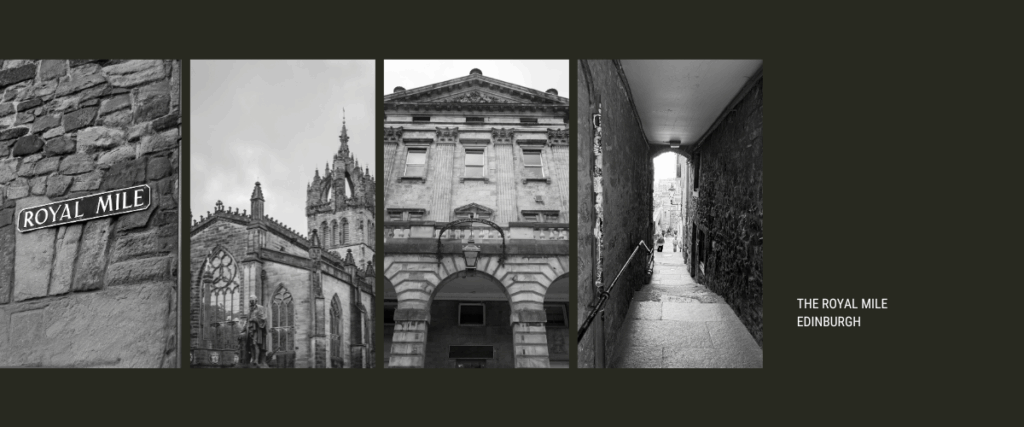
Where to Explore: Walking Through Luckenbooth
One of the pleasures of reading books set in Edinburgh is that you can walk straight into them. After finishing Luckenbooth, I wanted to trace its atmosphere in real space — to find the closes and corners that still hum with that gothic, layered energy.
The real Luckenbooths once stood on the High Street, a row of tall, narrow tenements that leaned up against St Giles’ Cathedral. They were demolished in the 19th century, but the idea of them — secretive, bustling, packed with life and death — survives in Fagan’s imagined address. To get in the mood, here are three places that capture something of her fictional tenement:
1. Lady Stair’s Close
Tucked just off the Lawnmarket, this is one of the most atmospheric corners of the Old Town. Stone steps, tight passages, and a courtyard that seems suspended in time. It’s home to the Writers’ Museum, dedicated to Burns, Scott, and Stevenson — literary ghosts who’d be right at home in Fagan’s spectral world. Stand in the close at dusk, and you can almost feel the layers of story pressing in from the walls.
2. Advocate’s Close
A few steps away, this steep, narrow lane drops dramatically from the High Street toward Princes Street Gardens, offering one of the best views of the Scott Monument. Its sharp descent and claustrophobic stone walls capture the city’s physical and emotional vertigo — the sense of being caught between light and shadow, intellect and sin. It’s easy to imagine the tenants of No. 10 Luckenbooth Close peering from one of its hidden windows.
3. Candlemaker Row and Victoria Street
Curving down from George IV Bridge toward the Grassmarket, these streets are pure Edinburgh eccentricity — colourful shopfronts layered on top of centuries-old vaults. They embody the novel’s mix of beauty and menace, past and present. Among their independent bookshops, vintage stores, and bars, you can sense the creative chaos that fuels both Fagan’s writing and the city itself.
A Final Thought
Reading Luckenbooth feels a bit like standing in the middle of Edinburgh during the Fringe: the noise, the ghosts, the poetry, the madness — everything pressing in at once. It’s not tidy or easily summarised, but it lingers. And that’s what I’m looking for in this series: books that don’t just use Edinburgh as a backdrop, but as a living, breathing presence.
Next month, I’ll choose another — perhaps something modern and sharply real after this fevered gothic. But for now, I’ll leave No. 10 Luckenbooth Close locked behind its door, echoing faintly with footsteps from another century.